










EU/UK is sinking into a war escalating morass of lies and demonization for something caused* by desperate rogue state US and its $-embezzling since 1971, now challenged by China's success.
* At least Trump now seems to try to do the right thing. After all, early this year he even admitted that US started the Ukraine war.

The blinking of the crystal clear and widespread neo-Nazi militants and their supporters in Ukraine, seems to indicate that EU itself is already on a slippery slope to full scale neo-Nazism - although called "defending democracy", and with Germany at the center stage again.
Peter Klevius recommends Consortium News (founded by Robert Parry on the video from 2015) if you want an alternative to Peter Klevius but with the same unbiased disdain for whom is targeted as long as it's the right way to report.
US officially confirmed Ukraine's strong Nazi connection but later blinked it.
In March 2015, Ukrainian Interior Minister Arsen Avakov announced that the Azov Regiment would be among the first units to be trained by US Army troops in the Operation Fearless Guardian training mission. US training however was withdrawn on 12 June 2015, as the US House of Representatives passed an amendment blocking any aid (including arms and training) to the regiment due to its neo-Nazi background.
However, the amendment was later removed in November with James Carden writing in The Nation that an "official familiar with the debate" told him that the "House Defense Appropriations Committee came under pressure from the Pentagon to remove the Conyers-Yoho amendment from the text of the bill." The decision was opposed by the Simon Wiesenthal Center which stated that lifting the ban highlighted the danger of Holocaust distortion in Ukraine, and by a Likud MP, but supported by Ukraine's Jewish community.
In 2018, the US House of Representatives again passed a provision blocking any training of the neo-Nazi Azov members by US forces. In October 2019, during Zelensky's presidency, members of the US House of Representatives from the Democratic Party requested that the Azov Regiment and two other far-right groups be classified as a Foreign Terrorist Organization by the US State Department. The request spurred protests by Azov's supporters in Ukraine, apparently including president Zelensky. Ultimately the regiment was not placed into the foreign terrorist organisation list. In early 2022 after the Russian invasion, the US continued to officially ban arms support to Azov via the yearly Consolidated Appropriations Act, 2022 following the 2018 provision. In June 2022, US Representative Jason Crow, who signed the 2019 letter, said he was 'not aware of any information that currently shows a direct connection [of Azov fighters] to extremism now', adding 'I am sensitive to the fact that the past isn't necessarily prologue here, that groups can change and evolve and that the war might have changed the organization'. However, prominent lawmakers, when pressed about monitoring this rule, stated "our main goal is to aid the Ukrainians in their defense", according to Senator Richard Blumenthal of the US Senate Armed Services Committee.
Zelensky's Jewish neo-Nazi connection
2019 Ukrainian Jewish billionaire Ihor Kolomoyskyi - who funded the neo-Nazi militia in Ukraine - owned 70% of the 1+1 Media Group whose TV channel 1+1 aired Servant of the People, a comedy series in which Volodymyr Zelenskyy plays a school teacher who becomes president of Ukraine on an anti-corruption platform. In March 2018, members of Zelenskyy's production company Kvartal 95 registered a new political party called "Servant of the People." They succeeded in getting Zelensky elected. Zelenskyy was viewed as Kolomoyskyi's candidate and appointed Kolomoyskyi's personal lawyer as a key campaign advisor; travelled to Geneva and Tel Aviv to confer with the then-exiled Kolomoyskyi on multiple occasions; and benefited from the endorsement of Kolomoyskyi's media empire. Once in office, Zelenskyy removed officials deemed a threat to Kolomoyskyi's interests, among them the prosecutor general, Ruslan Ryaboshapka, the governor of the National Bank of Ukraine (NBU), Yakiv Smolii, and Zelenskyy's first prime minister, Oleksiy Honcharuk, who tried to loosen Kolomoyskyi's control of a state-owned electricity company.
UK's support of Nazis in Ukraine has a long history.
At the end of WW2 UK firebombed defensless German civilians far from the frontline, while Russia defeated Nazi German's army. Churchill then asked US to join an attack against Russia while it was weakened because of the war against the Nazis.
UK also supported Ukrainian Nazis. MI6 said the Ukrainian Nazi leader Bandera’s group was ‘the strongest Ukrainian organization abroad, is deemed competent to train party cadres, [and] build a morally and politically healthy organization….’” An early 1954 MI6 summary noted that, “the operational aspect of this [UK] collaboration [with Bandera] was developing satisfactorily. Gradually a more complete control was obtained over infiltration operations.
Recent support of Ukrainian Nazis.
From the start of the 2013-2014 events in Ukraine, Consortium News founder Robert Parry and other writers began providing the evidence NewsGuard, which bills itself as a news-rating agency, says doesn’t exist. Parry began reporting extensively on the coup and the influential role of Ukraine’s neo-Nazis. At the time, corporate media also reported on the essential part neo-Nazis played in the coup
the neo-Nazi group, Right Sector, had the key role in the violent ouster of Yanukovych. The role of neo-fascist groups in the uprising and its influence on Ukrainian society was well reported by mainstream media outlets at the time.
Jeffrey Sachs: European Security Includes Russia
December 19, 2025
In an open letter in Berliner Zeitung, the author tells the German chancellor that peace in Ukraine cannot be achieved by pretending that Russia’s security concerns do not exist.
Chancellor Merz,
You have spoken repeatedly of Germany’s responsibility for European security. That responsibility cannot be discharged through slogans, selective memory or the steady normalization of war talk.
Security guarantees are not one-way instruments. They go in both directions. This is not a Russian argument, nor an American one; it is a foundational principle of European security, explicitly embedded in the Helsinki Final Act, the OSCE framework, and decades of postwar diplomacy.
Germany has a duty to approach this moment with historical seriousness and honesty. On that score, recent rhetoric and policy choices fall dangerously short.
Since 1990, Russia’s core security concerns have been repeatedly dismissed, diluted or directly violated — often with Germany’s active participation or acquiescence. This record cannot be erased if the war in Ukraine is to end, and it cannot be ignored if Europe is to avoid a permanent state of confrontation.
At the end of the Cold War, Germany gave Soviet and then Russian leaders repeated and explicit assurances that NATO would not expand eastward. These assurances were given in the context of German reunification. Germany benefited enormously from them. The rapid unification of your country — within NATO — would not have occurred without Soviet consent grounded in those commitments. To later pretend that these assurances never mattered, or that they were merely casual remarks, is not realism. It is historical revisionism.
In 1999, Germany participated in NATO’s bombing of Serbia, the first major war conducted by NATO without authorization from the U.N. Security Council. This was not a defensive action. It was a precedent-setting intervention that fundamentally altered the post–Cold War security order. For Russia, Serbia was not an abstraction. The message was unmistakable: NATO would use force beyond its territory, without U.N. approval, and without regard for Russian objections.
In 2002, the United States unilaterally withdrew from the Anti-Ballistic Missile Treaty, a cornerstone of strategic stability for three decades. Germany raised no serious objection. Yet the erosion of the arms-control architecture did not occur in a vacuum. Missile-defense systems deployed closer to Russia’s borders were rightly perceived by Russia as destabilizing. Dismissing those perceptions as paranoia was political propaganda, not sound diplomacy.
In 2008, Germany recognized Kosovo’s independence, despite explicit warnings that this would undermine the principle of territorial integrity and set a precedent that would reverberate elsewhere. Once again, Russia’s objections were brushed aside as bad faith rather than engaged as serious strategic concerns.
The steady push to expand NATO to Ukraine and Georgia — formally declared at the 2008 Bucharest Summit — crossed the brightest of red lines, despite vociferous, clear, consistent, and repeated objections raised by Moscow for years. When a major power identifies a core security interest and reiterates it for decades, ignoring it is not diplomacy. It is willful escalation.
Germany’s role in Ukraine since 2014 is especially troubling. Berlin, alongside Paris and Warsaw, brokered the Feb. 21, 2014, agreement between President Viktor Yanukovych and the opposition — an agreement intended to halt violence and preserve constitutional order. Within hours, that agreement collapsed. A violent overthrow followed.
A new government emerged through extra-constitutional means. Germany recognized and supported the new regime immediately. The agreement Germany had guaranteed was abandoned without consequence. The Minsk II agreement of 2015 was supposed to be the corrective — a negotiated framework to end the war in eastern Ukraine. Germany again served as a guarantor.
Yet for seven years Minsk II was not implemented by Ukraine. Kyiv openly rejected its political provisions.
Germany did not enforce them. Former German and other European leaders have since acknowledged that Minsk was treated less as a peace plan than as a holding action. That admission alone should force a reckoning.
Against this background, calls for ever more weapons, ever harsher rhetoric, and ever greater “resolve” ring hollow. They ask Europe to forget the recent past in order to justify a future of permanent confrontation.
Enough with propaganda. Enough with the moral infantilization of the public. Europeans are fully capable of understanding that security dilemmas are real, that NATO actions have consequences, and that peace is not achieved by pretending that Russia’s security concerns do not exist.
European security is indivisible. That principle means that no country can strengthen its security at the expense of another’s without provoking instability. It also means that diplomacy is not appeasement, and that historical honesty is not betrayal.
Germany once understood this. Ostpolitik was not weakness; it was strategic maturity. It recognized that Europe’s stability depends on engagement, arms control, economic ties and respect for the legitimate security interests of Russia.
Today, Germany needs that maturity again. Stop speaking as if war is inevitable or virtuous. Stop outsourcing strategic thinking to alliance talking points. Start engaging seriously in diplomacy — not as a public-relations exercise, but as a genuine effort to rebuild a European security architecture that includes, rather than excludes, Russia.
A renewed European security architecture must begin with clarity and restraint. First, it requires an unequivocal end to NATO’s eastward enlargement — to Ukraine, to Georgia, and to any other state along Russia’s borders.
NATO expansion was not an inevitable feature of the post–Cold War order; it was a political choice, taken in violation of solemn assurances given in 1990 and pursued despite repeated warnings that it would destabilize Europe.
Security in Ukraine will not come from the forward deployment of German, French, or other European troops, which would only entrench division and prolong war. It will come through neutrality, backed by credible international guarantees.
The historical record is unambiguous: neither the Soviet Union nor the Russian Federation violated the sovereignty of neutral states in the postwar order — not Finland, Austria, Sweden, Switzerland, or others. Neutrality worked because it addressed legitimate security concerns on all sides. There is no serious reason to pretend it cannot work again.
Second, stability requires demilitarization and reciprocity. Russian forces should be kept well back from NATO borders, and NATO forces — including missile systems — must be kept well back from Russia’s borders. Security is indivisible, not one-sided. Border regions should be demilitarized through verifiable agreements, not saturated with ever more weapons.
Sanctions should be lifted as part of a negotiated settlement; they have failed to bring peace and have inflicted severe damage on Europe’s own economy.
Germany, in particular, should reject the reckless confiscation of Russian state assets — a brazen violation of international law that undermines trust in the global financial system. Reviving German industry through lawful, negotiated trade with Russia is not capitulation. It is economic realism. Europe should not destroy its own productive base in the name of moral posturing.
Finally, Europe must return to the institutional foundations of its own security. The OSCE — not NATO — should once again serve as the central forum for European security, confidence-building, and arms control. Strategic autonomy for Europe means precisely this: a European security order shaped by European interests, not permanent subordination to NATO expansionism.
France could rightly extend its nuclear deterrent as a European security umbrella, but only in a strictly defensive posture, without forward-deployed systems that threaten Russia.
Europe should press urgently for a return to the INF framework and for comprehensive strategic nuclear arms-control negotiations involving the United States and Russia — and, in time, China.
Most importantly, Chancellor Merz, learn history — and be honest about it. Without honesty, there can be no trust. Without trust, there can be no security. And without diplomacy, Europe risks repeating the catastrophes it claims to have learned from.
History will judge what Germany chooses to remember — and what it chooses to forget. This time, let Germany choose diplomacy and peace, and abide by its word.
Respectfully,
Jeffrey D. Sachs
University Professor
Columbia University
Finnish Iltalehti's malicious and self-hurting Russophobia and Putin demonizing propaganda 20251218:
Iltalehti: Russia also demanded from NATO in late 2021, shortly before its large-scale invasion of Ukraine, that NATO would not expand eastward. Finland and Sweden joined NATO after Russia launched its large-scale war of aggression.
Peter Klevius: Finland's PM Sanna Marin decided already before the 1922 invasion to join NATO - which, together with NATO's and Ukraine's membership plan, in effect provoked Russia's reaction. Iltalehti deliberately disinforms by using the later formal decision, when the war was on and it was easier to get it through the parliament.
Iltalehti: Putin also repeated his false propaganda that the West has started a war in Ukraine. Putin also said that the people of Europe are being brainwashed by fear of war with Russia, and accused their leaders of inciting hysteria. This is seen as a response to NATO Secretary General Mark Rutte, who recently woke up Europeans to the threat posed by Russia.
Peter Klevius: US/Obama planned to take over Russia's military base on Crimea, and when it failed US/Obama then started the civil war against Russian speakers in Ukraine after having toppled the elected president. Add to this that before 2014 Putin had shown nil will to enlarge Russia, but on the contrary made every effort for peaceful trade relations with EU - which of course $-thieve (since 1971) US didn't approve of at all.
Finland's Mongol complex

Historically theocratic US led anti-Atheist and anti-Communist propaganda followed white supremacist eugenics, focusing on the Yellow Peril and Russians "wide cheek bones".
After WW2 strong efforts were made by US (e.g. 1952 Olympics and Miss Universe) to utilize the Finnish "mongol complex" so to stop "Finlandization", i.e. the lukrative peace and trade deal between Russia and Finland.
The difference between Baltic and Finnish Russophobia
Unlike Finland, the Baltic countries have a significant but oppressed Russian speaking population. However, when genetics revealed that non-Russian Balts had a mainly Western DNA, it just "confirmed" their Russophobia. But the Finns were "horrified" to learn that their main DNA was Siberian and East Asian, and made the Finns "mongol complex" even worse. So no wonder Finland was an easy target for US nukification (NATO and DCA) - not the least because of then PM Sanna Marin's betrayal of her party voters and her country.
True Finns of 2025

The Finns Party's anti-Chinese racism is the main reason Finland is the only in EU with no growth at all.
Unlike
German and French right wing parties, the extreme right wing Finns
Party supports the corrupt neo-Nazi influenced Ukraine's war (starting
2012-2014 with the support from US) against its Russian population.
True
(Sinopphobic) Finn, Juho Eerola, member of the Finns Party which is
part of the Finnish government. His aid Ulla Pyysalo, applied for
membership in the neo-Nazi organization the Finnish Resistance Movement
that Eerola for political reason has left. Finns Party MPs Juho Eerola
and Kaisa Garedew, together with MEP Sebastian Tynkkynen, also
participated in racist anti-Chinese actions.
However, the Finns
Party seems to have no problem with the extremist Jewish party in
Knesset that made Israel's continuing genocide against Palestinians
possible.
As a basic (negative) Human Rights follower non-muslim
Peter Klevius defends Palestinians against Israels's occupation, land
grabs and genocide, while criticizing islam - because to do so is made almost impossible for muslims by their own religion and aided by Western support for islamofascism when it suits the West.
So why is AI lying about Peter Klevius?!

Nowhere on the web can you find Peter Klevius criticizing China about Numan Rights. Compared to $-embezzler (since 1971) US, China looks almost like a model country. US is the one that has systematically removed itself from Human Rights with the help of its theocratic* Supreme Court. And just consider that US supports Israel's occupations, war crimes and genocide, and calling Hamas a terrorist organization, while removing the same label from the Uighur terrorists. In 2018 the US was at war with Uyghur terrorists, but With China now in the crosshairs, the ETIM has become an asset. However, although the terror was at least at the same level and in Israel, China didn't start a war but did the onle right thing, i.e. deradcalization, added with the release of sharia trapped women for education and woirking careers.
* Although, most US people are Atheists, the Supreme Court is 100% theocratic.
This 1988 ad by Finnair reveals a wider institutionalized Western racism .

When a young Peter Klevius swapped his VW that had stopped working with nowhere near 100,000 km on the odometer, for a Japanese Mazda (see below) he immediately realized the superior technological quality. So why where people anti-Japanese? Next proof came in the 1980s when Peter Klevius worked for the Finnish broadcasting company YLE, as a reporter and presenter, and was given a heavy and clumsy "portable" Nagra tape recorder, that distorted the sound if one moved with it, and could only record for 10-15 minutes. However, on the shelf there was also a tiny Sony WM-D6 Professional cassette recorder, so he asked the sound engineer why not use this instead of the Nagra, The answer was again that it was Japanese and only there for testing and when Nagras were either busy or out of order. So Peter Klevius begged to try it, and when coming back the sound engineer was stunned with the sound quality. Moreover, it could record for two hours (one hour without stopping) and one could walk and run with it without distorting the sound.
However, today China/Taiwan is the tech leader, although the other "slanted eyes" people from Korea and Japan also outperform Europe and US. Is the reason to "slanted eyes" racism due to US and European delusion of being the smartest?
Peter Klevius wrote:
Wednesday, May 18, 2022
Shame on you Finland! Why risk yourself and others by defending a criminal* loser** like $-freeloader US (unless US causes a nuke war) against a certain winner like China?!
* 1971 USA robbed the world by
cheating on its promise to keep the dollar connected to gold in exchange
for the dollar being the world currency. In other words, all other
currencies dropped compared to the dollar which now became a
"schizophrenic" currency with an A-dollar in US and a B-dollar in all
other countries. And although every country may print as much own
currency they like, it comes with a cost it has to carry itself while
the US dollar printing is paid for by the rest of the world. Only
inflation is a risk for US - but not as much as outside US (except
China).
** US has already lost its position as the largest
economy to China, and is also fast losing in every high tech branch and
science - while China is on its way up. This is why US so desperately
tries to contain China and force other countries under US rule against
China. However, ask youself which is better: Belt and road or nukes?
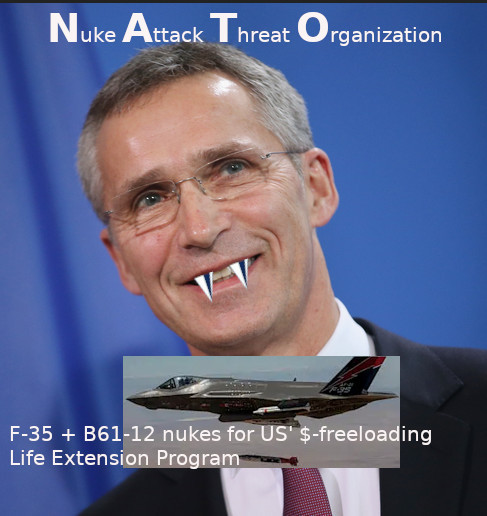
F-35A + B61-12 + NATO makes Finland a U.S. base for nuke threat/attacks against Russia - and ultimately China!


The
Finns are now lured into NATO when the West is collapsing. A
combination of US influence and a longlasting Finnish mongoloid complex
that they weren't Western enough. Finnish Russophobia started with the
grim Finnish civil war 2018 influenced by the US led Red Scare campaign
which is the promotion of a widespread fear of a potential rise of
communism, anarchism or other leftist ideologies by a society or state.
It is often characterized as political propaganda. The term is most
often used to refer to two periods in the history of the United States
which are referred to by this name. The First Red Scare, which occurred
immediately after World War I, revolved around a perceived threat from
the American labor movement, anarchist revolution, and political
radicalism. The Second Red Scare, which occurred immediately after World
War II, was preoccupied with the perception that national or foreign
communists were infiltrating or subverting U.S. society and the federal
government.
Peter Klevois wrote:
Saturday, March 03, 2018
Klevius: What are the "brits" complaining about?
What's your problem? Snow and ice was the funniest time to drive - and not a single accident in any of the long dark Nordic winters.
Update:To avoid any misunderstanding it should be noted that Peter Klevius did crash out once - in the summer - and only because the garage had replaced only three of the shock-absorbers (without telling*), leaving left front wheel going deep down (while the rest of the car was steady) in a sharp downhill right sandy corner that Peter Klevius had driven thousands of times before - and faster - without any problem. And because the garage owner and his wife were close friends with Peter Klevius and his wife, Peter Klevius decided to take all the blame (i.e. fine) and spare his friend from disaster.
* Only after the crash did he admit that he couldn't replace left-front shock-absorber because it was so rusty. Peter Klevius didn't ask for any compensation.
Update: Due to a reader's question - no,
Peter Klevius almost never used
studded winter tires (only for a short time when they came with the
car). Non-studded but soft tires with big patterns were by far to prefer
if you knew how to drive - not to mention that studded tires could be
quite dangerous during e.g. times of thawing, (wet and bare tarmac etc).
Moreover, Peter Klevius also lowered the tyre pressure so to get even
more "sticky" behavior.
Here's Peter Klevius' first Japanese car, a Mazda Luce 1967 - beautiful and the world's highest* quality - bought used with lots of mileage on it, which later crashed due to garage failure. The man on the car is Tjalle and has nothing to do with the crash.
* UPDATE: Toyo Kogyo in Hiroshima (nuked 1945 by US) produced machinery tools with the smallest tolerances, for the automotive industry - and proved this by producing a rotary engine that the best German industry failed to get working. When Peter Klevius VW broke down not even reaching 100000 km, he saw a dream car in a used car shop and asked the seller how it could be so cheap. He was told it was a learner car driven almost 200000 rough km - and that because it was Japanese it was harder to sell. Peter Klevius bought it and added almost 200000 more km.

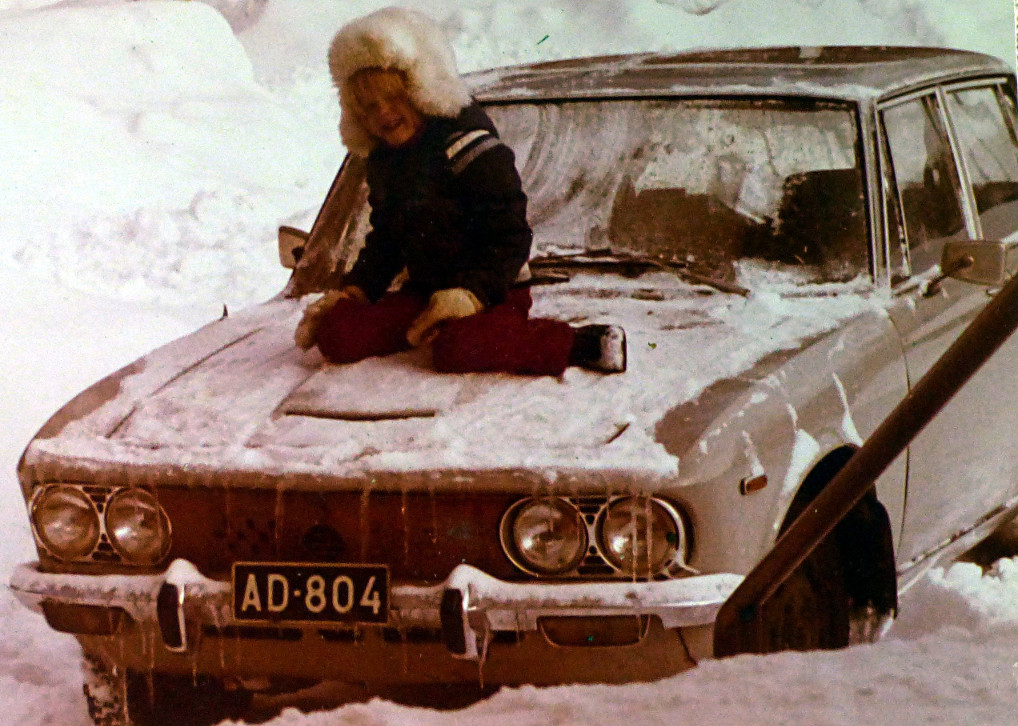
When Klevius was a young newly divorced dad, he drove some 100 km every day to his office job in the city no matter how much snow or ice, leaving and picking up his child, shopping etc. before landing at our countryside home and making a delicious dinner for the two of us.


No comments:
Post a Comment