From a naive simplified out-of-Africa paradigm science has now confirmed with 100% certainty that what we could call truly modern humans evolved outside Africa and only later mixed with pre-modern Africans. However, Klevius was, it seems, first to hypothesize about it (1992 and as a theory 2003). And although there is still a lot of quarreling about details, only ignorant journalists and willfully ignorant laymen/"scientists" continue babbling the politically correct out-of-Africa mantra.
Klevius cannot accept that Africans would be less capable than Europeans to accept their inferiority compared to those guys whose cultural tracks can be seen on the map above.
From the Denisova cave and Baykal in Siberia in the east to Western
Europe stretches a belt of extremely advanced human culture dated to
between some 40,000 to 25,000 years ago.
Nowhere else in the world have we found anything even close to this!
However, the pattern follows exactly Klevius' theory Out of Africa as
bipedal apes and back as global mongoloids. And although Klevius' theory
was published on the web before we knew about Homo floresiensis, this
strange creature as well as Denisovan also beautifully fit in Klevius'
proposed scenario.
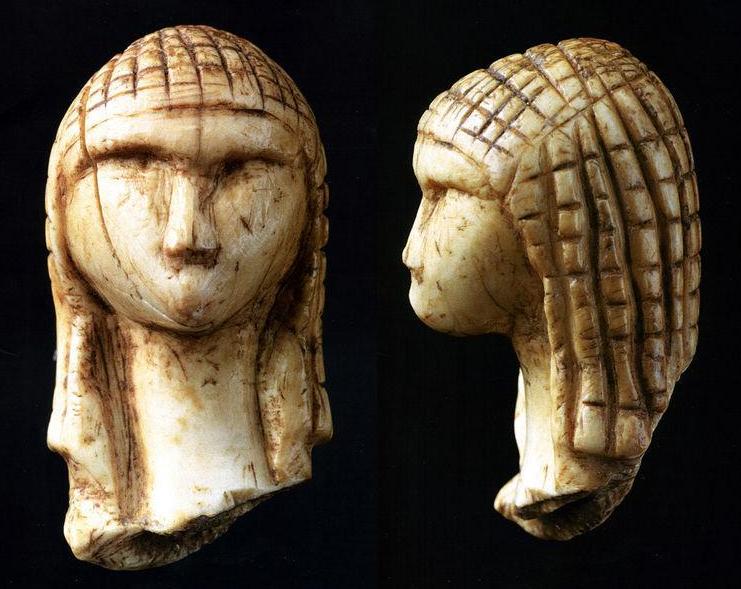
Klevius map on the cultural
explosion that marked the birth of modern humans in Eurasia more than
40,000 years ago. Do note that the Lion Man has been re-dated to 40,000
BP. The Malta portrait is dated to 26,000 BP but could be older.
Klevius is an evolutionary bastard (the gray "bastard belt" on the map below) created when the modern mongoloid humans from Siberia mixed with pre-moderns from the south. The red symbolizes pre-colonial mongoloids. However, also consider the mongoloid Khoe-San in southern Africa who are the remnants of an early "back migration" of modern humans out-of-Asia.
This extremely sophisticated bracelet from Altai/Siberia represents the hereto
most advanced early artifact ever found in the world. It was located nearby the
non-human "Denisovan" in Siberia. Although no serious criticism has been made against its dating etc. no one seems to dare to talk about it due to the anomaly it represents, namely the very opposite to every thought based on a naive out-of-Africa scenario. Please visit
Klevius anthropology blog and find out why this bracelet, in fact, represents the most logical and self evident explanation to the rapid evolution of the truly modern humans some 40-50,000BP and its later spread and mixing throughout the world.
Let's profile Klevius thinking* to a recent blog post by John Hawks
* if you want to assess the thinking capabilities of Klevius, please visit EMAH - the even more astonishing hypothesis!
The text is 20 years old and first was presented on the web in 2003
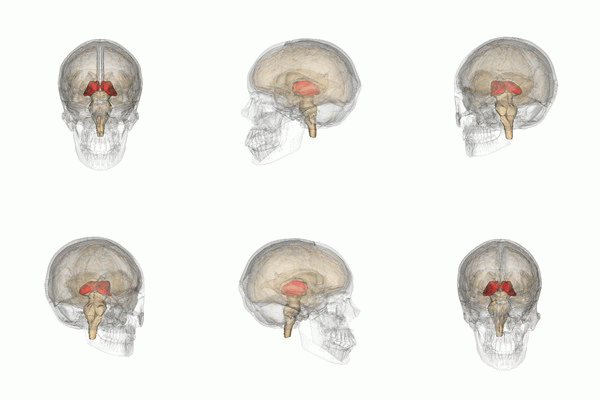
(EMAH is about Thalamus and interestingly RIKEN in Japan started its
world leading Thalamus research in 2004).
To give you a background to the art map above while simultaneously spicing it with a black web troll's racist charlatanism, please read John Hawks take on Denisovans and Neanderthals with additional comments by Klevius.
From John Hawk's blog: Sheila Mishra and colleagues have a new paper discussing the
antiquity of microblade industries in India, focusing on the site of
Mehtakheri in Madhya Pradesh, for which they report new OSL dates on
microblade-bearing layers going back some 45,000 years
[1].
Microblades are relatively small, thin flakes of stone, generally
intended to be hafted onto a handle of wood, bone or other material.
These small tools are not useful by themselves; they break readily and
only function when supported by some armature. The production of such
small thin flakes requires a fairly specialized series of choices in the
reduction sequence, and the stone cores from which these microblades
were struck are easily recognized by archaeologists.

Figure 11 from Mishra and colleagues (2013), CC-BY. Original caption: Figure 11. D3, F1, M25, J15 and M23 are microblade cores.
J39 is a trimmed nodule. J2 is is a retouched flake on multicoloured
chert and M9 is a perforator made on a platform rejuvenation flake. J44,
D107, A42 and I41 are hammerstones of various sizes. C26, D26, D78, C3
are broken flakes and M22 and M13 complete flakes. K1 and M2 are from
the initial stages of core reduction showing the much larger initial
size of the cores. M 2 also retains a part of the crested guiding ridge.
doi:10.1371/journal.pone.0069280.g011
I'm going to use this new paper as an occasion to visit the
archaeological record of Late Pleistocene India, stretching across a
number of posts. In this one, I'll examine Mishra and colleagues'
discussion of the Denisova genome.
Readers following this story will remember that Michael Petraglia and
colleagues have, through a series of articles, argued for technological
and cultural continuity in southern India from as early as 77,000 years
ago up to around 38,000 years ago (for example, reviewed in
[2]).
This time span stretches across the horizon created by ash from the
Toba, Sumatra volcanic eruption, one of the most geologically visible
events in the Late Pleistocene, and Petraglia and colleagues have shown
this continuity at Jwalapuram in levels both under and above the Toba
ash. That finding connects to 15-year-long debate in paleoanthropology
about the importance of this volcanic event. By the account of Petraglia
and colleagues; the Middle Paleolithic industry of south India has
technical similarities to Middle Stone Age industries of Africa, and
based on its timing and continuity is likely to have been produced by
modern humans.
Meanwhile, Paul Mellars and colleagues have argued in a series of
articles that the appearance of modern humans in South Asia was
accompanied by the first systematic production of microblades as part of
a rather more advanced technical repertoire (for example,
[3]).
In Mellars and colleagues' view, modern humans in India originated in
Africa with a dispersal that occurred sometime after 60,000 years ago.
They argue that the microlithic assemblages have clear technical
similarities to production of Howieson's Poort toolkits in southern
Africa, and suggest that the dispersal carried this cultural information
and technical abilities rapidly across southern Asia and ultimately to
Australia.
I will investigate both these points of view more fully. As you can
see, it is a debate that is fundamentally about the timing of "major
dispersal", the importance (or lack of importance) of local technical
continuity, and the similarities (or lack of similarities) of South
Asian industries with MSA African industries. Both groups have addressed
mtDNA evidence for the timing of population growth in South Asia; this
evidence is unsatisfactory in one way or another to both.
Why Denisova is important
Neither group has, to date, addressed the relevance of the Denisova
genome to the dispersal of humans across South Asia. To my mind, there
is a singular point that any hypothesis must accommodate:
indigenous
Australians and Melanesians have substantial Denisovan ancestry, South
and Southeast Asians, and peoples of Java, Sumatra and Borneo have at
most a trace of Denisovan ancestry (
"How widespread is Denisovan ancestry today?").
We can't easily explain this pattern without multiple waves of
population movement into Southeast Asia.
Klevius: Yes, we can. If Denisovan was born as a hybrid between "humans" (M130) and
something
similar to Homo floresiensis (from whom we lack DNA) who had the
brightest brain ever seen when compared to its size, then this hybrid
would have constituted the root of modern humans. And on its path
northwards it met and mixed with erectus and eventually the big headed
neanderthals.
John Hawks: The later wave (or waves) of
movement must have happened after the initial spread of people who would
colonize Australia and Melanesia. This later wave (or waves) must have
made up the vast majority of the ancestry of later Southeast Asians,
including today's hunter-gatherer peoples of mainland Southeast Asia and
the peoples of the Andaman Islands.
The source of this later wave must
have been from some population that had Neandertal ancestors but did not have Denisovan ancestors.
Klevius: "The source of this later wave must
have been from some population that
had Neandertal ancestors but did not have Denisovan ancestors." According to Klevius theory
Out of Africa as bipedal apes and back as global mongoloids,
mongoloid Shompen, for example, may represent a relict of the first
back migration from Siberia as modern mongoloid humans (compare Khoe-San
in Africa).
Mixed Shompen group photographed in 1886.
A black supremacist in his racist rant actually seems to support Klevius
Posted by Vansertimavindicated (Member # 20281) on 05 August, 2012 11:22 AM:
Do not even listen to these devils when they try to humanize Denisovan and Neanderthal yall!
I just want to momentarily interrupt this clown show and show you the
"negritos" of South East Asia that the ignorant, pink assed monkey
referred to above. These are the negritos that the devil proclaimed to
be the most genetically distant human population from Africans at most
loci studied thus far (except for MC1R, which codes for dark skin).
These are the direct descendants of ALL Asians yall, and their DNA is
strictly Asian However they do share something in common with Africans,
and thats ZERO% Neanderthal admixture.
Do not even listen to these
devils when they try to humanize Denisovan and Neanderthal yall!
Denisovan and Neanderthal were both 48 chromosome apes, more distant to
Homo Sapien than a Gorilla or a Chimp. These apes addedd their genetic
material to a small group of people in CENTRAL ASIA and CENTRAL ASIA
ONLY! it did not happen in Europe and there is no evidence whatsoever
that this happened in Europe, but there is a plethora of evidence that
this happened in CENTRAL ASIA and that this is where the cracker and the
mongoloid DEVOLVED!
You
have to kinda wonder why the incompetant low IQ monkey would even bring
up indigenous South East Asian "Negritos" because the only unmixed ones
left on the planet are
1) the Sentinelese
2) the jarawa tribe
3) Great Andamanese
4) the Onge tribe
Is
this monkey just incompetant and ignorant or does it know the
implications of a people traveling the coast of Arabia and Persia until
reaching India
You really have to wonder why this degenerate
would even go there because these people still exist, WE HAVE THEIR DNA,
they are a living people, so we dont have to look at pictures of modern
populations that this monkey loves to apam and guess what they looked
like.
I guess the filthy pink assed liar believes that it can
explain away why these people possess ZERO% Neanderthal and ZERO%
Denisovan DNA. You see these folks have been isolated and have remained
unmixed for HUNDREDS of THOUSANDS of years and are an Asian people.
WHATS THE DEAL WITH YOU MONKEY? ARE YOU REALLY THIS INCOMPETANT? ARE YOU TRYING TO FIGURE OUT A WAY TO EXPLAIN THESE PEOPLE?
I suspect its a bit of both for this reprobate
Hey
yall, let me show you what it looks like when mongoloids invade black
populations! These look like anything you would see in South America
dont they? Thank god that people like the Jarawa and Sentinelese tribes
were fierce enough to fight off these mongoloids and keep their blood
pure! Otherwise you would have pink assed monkeys calling these people
INDIGENOUS! LOL in fact many folks call these people indigenous. Just
look at wikipedia
http://en.wikipedia.org/wiki/Shompen_people
However
DNA irrefutably proves that these people are NOT indigenous, in fact
they are filled with Neanderthal and Denisovan DNA just like the
fraudulant so called NA in the americas!
DNA IS KILLING THESE
PATHETIC WHITE DEVILS! ITS KILLING THEM! YOU CAN JUST LOOK AT THESE
FOLKS AND SEE THAT THEY ARE NOT INDIGENOUS, BUT THEIR DNA IRREFUTABLY
PROVES THAT THEY ARE NOT. NOW A HOMEWORK ASSIGNMENT YALL!!! GO TRY AND
FIND INFORMATION ON THE SHOMPEN... IT DOES EXIST
http://www.youtube.com/watch?v=fcLr22O6pl0
Posted by Vansertimavindicated (Member # 20281) on 05 August, 2012 11:35 AM:
DNA is destroying these filthy devils! Let me show yall what the first Asians AND the first South Americans looked like yall!
1)
The first Asians and South Americans. It should be noted that these
people possess ZERO% Neanderthal and denisovan admixrure today just as
they possessed ZERO% Neanderthal and Denisovan DNA when they first
entered Asia and the Americas!
2) The first Europeans and North
Americans. It should be noted that these people possess ZERO%
Neanderthal and denisovan admixrure today just as they possessed ZERO%
Neanderthal and Denisovan DNA when they first entered Asia and the
Americas!
THIS IS WHY YOU HAVE THESE FILTHY PINK ASSED CRACKER DEVILS LYING THEIR PINK ASSSES OFF!
Posted by Vansertimavindicated (Member # 20281) on 05 August, 2012 11:44 AM:
Do not even listen to these devils when they try to humanize Denisovan
and Neanderthal yall! Denisovan and Neanderthal were both 48 chromosome
apes, more distant to Homo Sapien than a Gorilla or a Chimp. These apes
addedd their genetic material to a small group of people in CENTRAL ASIA
and CENTRAL ASIA ONLY! it did not happen in Europe and there is no
evidence whatsoever that this happened in Europe, but there is a
plethora of evidence that this happened in CENTRAL ASIA and that this is
where the cracker and the mongoloid DEVOLVED!
And thats why you
never hear of any ancient white or mongoloid civilzations and its also
why you never hear of any Archaeological digs in central Asia
Mongolid= Denisova
Caucasoid = Neanderthal
Both
the caucasoid and mongoloid are the offspring of 48 chromosome apes
that did not leave central asia until after 1500 BCE. And we know what
happened when both of these sub species left their caves in central Asia
too!
Klevius: So what do you think about that John? Can I rest my case?
John Hawks: If we imagine Denisovans may have lived in China,
or in South Asia, then the extent of later waves of movement must have
been even greater, coming from even farther away. If we imagine that the
Denisovans had lived in South Asia, then the later wave of movement
must have followed very soon after 60,000 years ago, given the evidence
for early population growth of the ancestors of current South Asian
populations
[4].
Can we escape from this problem by hypothesizing that the Denisovans
only lived in Java, and mixed with the ancestors of aboriginal
Australians there? Setting aside the fact that the Denisova genome
itself was found more than 5000 kilometers away, we must still deal with
the apparent lack of Denisovan ancestry in any of the populations of
Indonesia west of the Wallace Line. We must have a second migration, and
given the diversity of today's populations, that second migration must
long predate the Neolithic population expansions that also characterize
the region.
Klevius: The "second migration", according to Klevius theory,
departed fromSiberia and spread in all directions due to the advantage
of the new brain structure poured into the big Neanderthal skulls. On
its way west/southwest it mixed with Afro-European archaic moderns, but
to the east/southeast it kept its mongoloid characteristics.
John Hawks: In reality, talking about "waves of migration" is unnecessarily
specific. I think every population movement included newcomers
interacting with the previous inhabitants. We may be talking about a
continual flux of people across southern Asia. In the end, we are
restricted by only a single fact: today's degree of Denisovan ancestry
appears to be nearly uniformly low or zero everywhere that contacted the
Asian mainland during the Late Pleistocene. If that apparent fact turns
out to be wrong, we'll have to revisit the rest of these assertions.
Microblades and moderns: The "mysterious connection" between South Africa and South
Asia
Mishra and colleagues
[1],
demonstrate that the microlithic assemblages in India extend as far
back as 45,000 years ago. At first glance, this might seem to agree with
the Mellars interpretation, but in an e-mail, Mishra indicated to me
that she essentially agrees that the earlier non-microblade tradition is
also modern humans, but that this industry does not share close
technical links with Arabia or West Asia. They propose that the
microblade industries mark a connection between South Africa and South
Asia as a result of migration from Africa within the last 60,000 years.
(this paragraph reflects updates relative to the original post,
22-07-2013).
By doing so, they create a mystery: Why did technology mark this
later period of movement, but not earlier dispersals? If there really
are technical and biological ties between Arabia and Nubia (
"Jebel Faya and early-stage reduction"),
why did these people not spread further, along the coast of southern
Asia? And how did modern humans arrive at such an early date in
Australia, if they were unable to penetrate India?
To answer these questions, Mishra and colleague propose an archaic
population of South Asia that was highly competent and competitive with
modern humans. They draw upon the hypothesis that Neandertals replaced
modern humans in the Levant after the initial habitations evidenced at
Skhul and Qafzeh. This example may show that modern humans were not well
suited to certain climatic and ecological challenges before the
appearance of the microblade toolkit.
Sharp differences in the stone tool technology of modern
humans in the Indian Subcontinent and Southeast Asia exist throughout
the Late Pleistocene [19]. This would not be the case if modern humans
had reached there from the Indian Subcontinent. Although the evidence is
still not conclusive, it appears that modern humans reached Southeast
Asia during MIS 5 from a different route and earlier than the Indian
Subcontinent. Given the rapidly accumulating evidence for the presence
of modern humans in Arabia during MIS 5
[26,27,39,40,41,42,43,44,45,46,47,48], an explanation for their failure
to disperse into the Indian Subcontinent at that time, is required. We
suggest that the Indian Subcontinent during MIS 5 times was occupied by a
population derived from Homo erectus adapted to the Indian environment
from Lower Pleistocene times onwards. This population would be
“archaic”, and the Narmada hominin would be ancestral or a
representative of it. Competition between Indian archaics and modern
humans would have been intense since they were adapted to similar
environments. Failure of modern humans to disperse into the Indian
Subcontinent during MIS 5 was probably due to their failure to
successfully compete with the Indian archaics during a period when the
climatic conditions were favourable to both. However during the MIS 4
times, when the desert zones of Africa and Arabia were abandoned and
more favourable zones in the Middle East such the Levant and Iran were
occupied by Neanderthals, modern humans had more success in entering
India and a major change in the Indian Palaeolithic record then
occurred. The expansion of modern humans into India therefore coincides
with the expansion of Neanderthals into the Middle East at the expense
of modern humans and into Central Asia possibly at the expense of
Denisovans.
In the place of a "southern route" hypothesis for the colonization of
Australia, Mishra and colleagues present an alternative: Migration
around the northern tier of South Asia, possibly through southern
Siberia and China.
The contrast between the technology associated with
modern humans in the Indian Subcontinent and Southeast Asia is present
right from the earliest presence of modern humans in the two regions
thus making it more likely that modern humans reached Southeast Asia
from Southern China rather than that the differences emerged after
modern humans reached Southeast Asia from India. The variation in the
degree of Neanderthal and Denisovan ancestry in present day populations
can also be explained by an earlier dispersal of modern humans to SE
Asia via China rather than the Indian subcontinent. Denisovan ancestry
is significant in Island but not mainland SE Asia [72]. This is
explained if populations in Island SE Asia are descended from
populations which spread through China when Denisovan populations were
still present. Present day Chinese have different and greater amounts of
Neanderthal ancestry than populations elsewhere [73]. but lack
significant Denisovan ancestry [72]. This could be due to admixture with
Neanderthals in Central Asia when modern humans expanded from there
into China during MIS 3 times after Denisovians had become extinct.
That seems at first glance like a highly counter-intuitive take on
the evidence. The hypothesis: Modern humans first reached Southeast Asia
via China, with little or no input from India. Three elements of this
hypothesis accord well with the data as they stand:
1. The earliest modern humans now known from China appear to
substantially predate the appearance of microblade toolkits in the
Indian subcontinent. These include Zhirendong (
"Zhirendong puts the chin in China") and plausibly Liujiang. Liujiang has been associated with a minimal date of 68,000 years ago, and arguably is twice that age
[5], but remains debatable because of the circumstances of its discovery
[6].
In addition to these, there are several sites with teeth or more
fragmentary remains that also might represent early modern humans in
China, and there are some very early occupation sites in Southeast Asia.
I'll review these in a later post.
2. As Mishra and colleagues suggest, the Southeast Asian
archaeological record seems to follow a different trajectory than the
South Asian record across much of this time period. That is also true of
the Indonesian archaeological record of the Late Pleistocene.
3. The lack of Denisovans in South Asia helps to contain the problem
of no Denisovan ancestry to Southeast Asia. This is possibly the most
minimal scenario. Further, the later immigration of microblade-using
peoples into South Asia would provide a source population for further
migrations into Southeast Asia and Indonesia that would lack Denisovan
ancestry.
Can we avoid South Asia?
I have my doubts. I think Mishra and colleagues are on to something
very interesting, but I am not convinced it has to do with the earliest
movement of modern humans.
Most important, I am not convinced that the technical similarities
among industries were produced by the biological movements of peoples.
For example, Howieson's Poort was a localized and short-term industry
without compelling technical connections to later peoples of southern
Africa. Sure, it is self-evident that the existence of Howieson's Poort
shows that its makers were capable of making it. But why would a
microblade tradition take hold in India but not other destinations of
these people, including within Africa? And why did the technology
persist for so long in India when it was far more ephemeral elsewhere?
These questions necessitate local ecological and cultural answers. The
strength of ecology and culture history in maintaining these industries
in India must have outweighed the importance of drift and ecological
factors in other regions.
But if so, then surely the microblade
industries are much more likely instances of convergent technical
solutions than lineal cultural relations.
I recognize that this is a general argument against the use of
technical similarities as markers of population relationships. It is
just as applicable to the similarities of Jebel Faya and the Nubian
complex, for example, or to the linking of Indian Middle Paleolithic and
MSA African industries proposed by Petraglia and colleagues.
But the evident diversity of the MSA record of Africa, with a rapid
invention, local proliferation, and frequent disappearance of such
interesting elements, makes it very likely that technical links will
appear by random chance with toolkits elsewhere. Let's consider the
technical similarities of Mousterian Neandertals -- including ornament
production, pigment use, and blade production -- with MSA peoples of
southern Africa. Should we believe that these ancient people were linked
by an unbroken chain of ideas, so much so that we can infer they were
members of a single migrating population?
Probably not.
But we focus too much, perhaps, on similarities. The differences
between southern African and Neandertal industries are meaningful, both
in terms of ecology and cultural connections. And I think the most
interesting part of the current paper is the way Mishra and colleagues
reflect upon the technical differences between South and Southeast Asia
and China. This means something. The peoples of these regions retained a
strong pattern of technical difference in the wake of a time when
modern humans had, by some accounts, cruised rapidly across the southern
tier of Asia on their way to Australia. These differences may disprove
the model and require a more complex scenario of population movement and
mixture.
That more complex model may help us make sense of the Denisova genome
and its legacy among living peoples. The archaeological evidence is
going to help us sort this story, and I am pleased to see it developing.
Roger Blench: Shom Pen joins the select club of language isolates in Eurasia, along with Burushaski, Nahali, Basque and Kusunda.
Klevius: "It appears that modern humans reached Southeast
Asia during MIS 5 from a different route and earlier than the Indian
Subcontinent".
Only by placing the birth of the Denisovan linage near Homo floresiensis can we make sense of available data so far.